

Additional information
| Weight | 2 kg |
|---|---|
| Dimensions | 35 × 35 × 25 cm |

* Actual products may vary slightly due to continuous design enhancments.
To ensure a safe, reliable, and long-lasting installation, you'll need the following components:
Always ensure the suspension system and mounting hardware are suitable for the weight of the High Bay and securely attached to the building structure. Electrical connections should be installed in accordance with applicable electrical regulations and by a suitably qualified person.
Using the correct mounting hardware, safety support, and electrical components will help ensure a secure, reliable, and long-lasting High Bay installation.
3CCT 18 000lm 3 Year Warranty
Online Price:
R911.00 Original price was: R911.00.R828.00Current price is: R828.00. Vat Incl.
| Input | 230V DC |
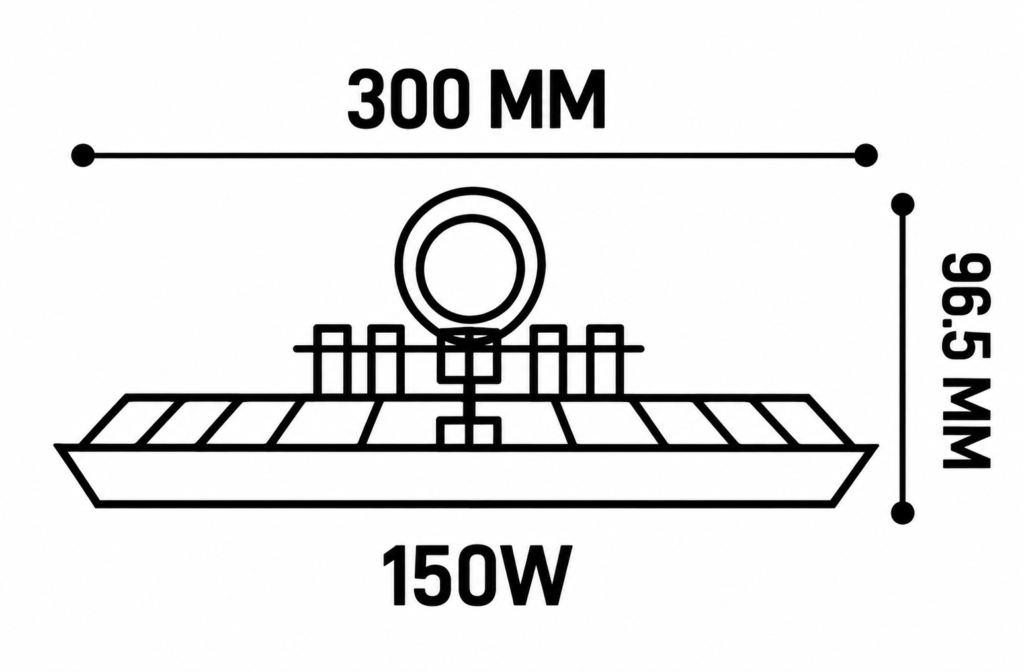
| Output | 150W |
| Lumens | 18 000m |
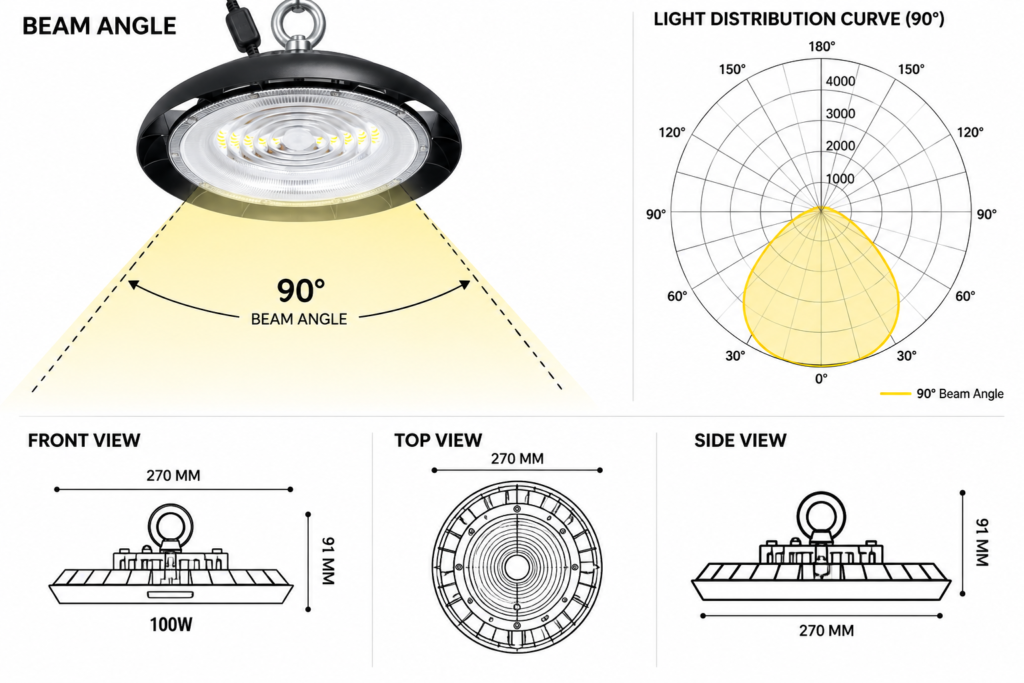
| Beam Angle | 90° |
| Colour Temperature | CCT |
| Dimensions | 300mm x 96.5mm |
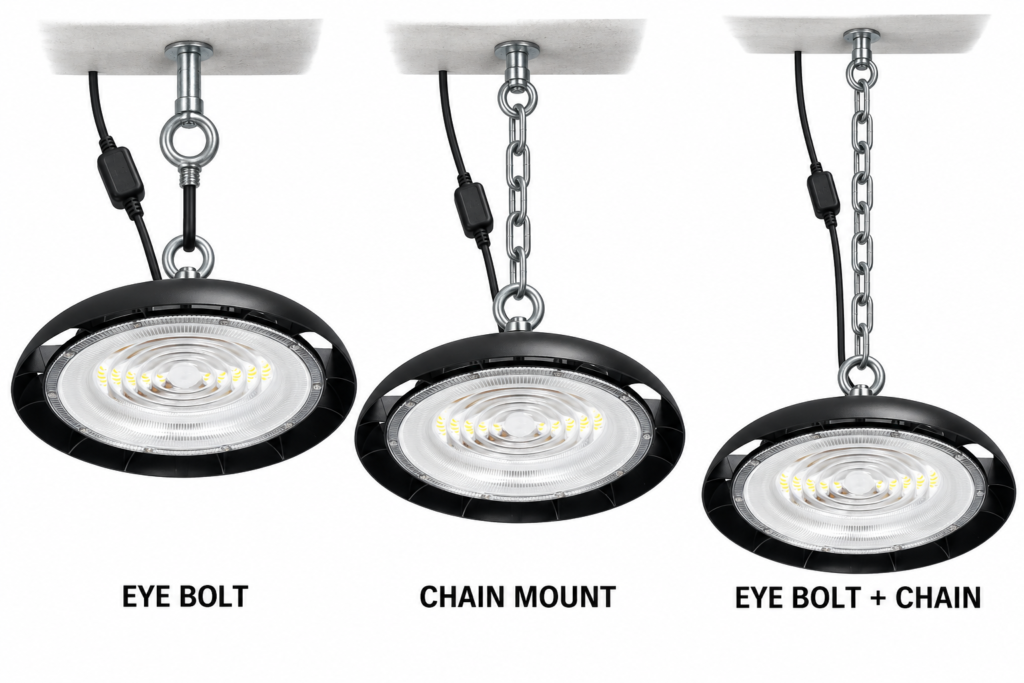
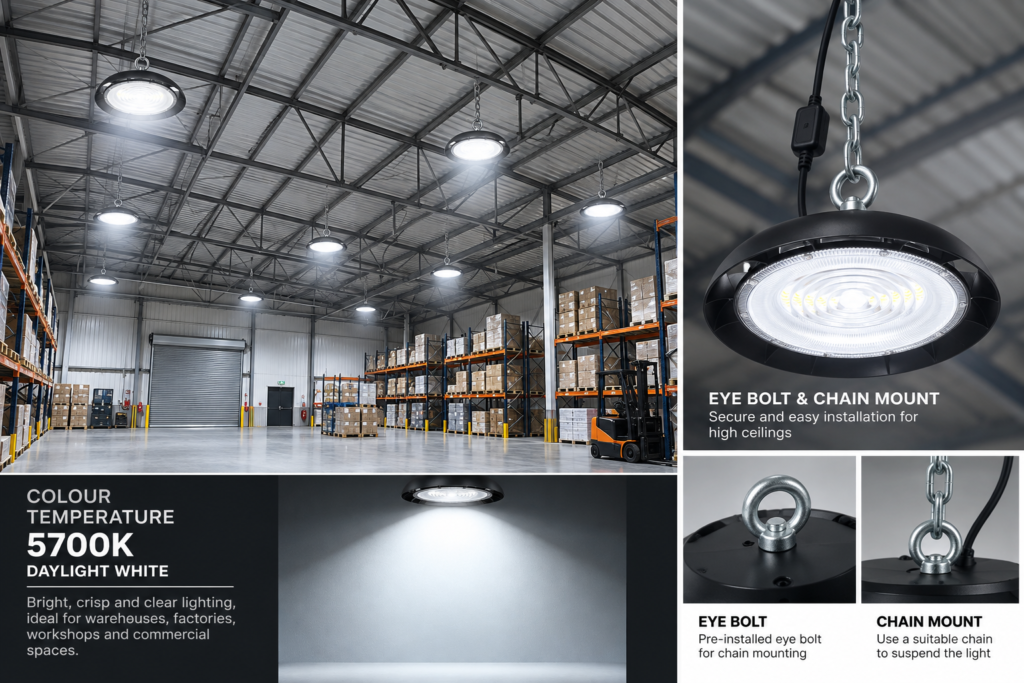
| Mounting | Chain Mount / Eye Bolt |
| IP Rating | IP65 (Water Resistant) |
| Warranty | 3 Year |
27 in stock (can be backordered)




To ensure a safe, reliable, and long-lasting installation, you'll need the following components:
Always ensure the suspension system and mounting hardware are suitable for the weight of the High Bay and securely attached to the building structure. Electrical connections should be installed in accordance with applicable electrical regulations and by a suitably qualified person.
Using the correct mounting hardware, safety support, and electrical components will help ensure a secure, reliable, and long-lasting High Bay installation.
What accessories do I require for a basic LED High Bay installation?
For a basic suspended installation, you will generally require:
The High Bay should be securely mounted to a suitable structural point and connected to the correct electrical supply.
Are there any optional accessories I may need?
Depending on your installation, you may also require:
The accessories required will depend on the mounting method, installation environment, and specific High Bay model.
What electrical supply does a High Bay require?
Always check the product specifications for the required input voltage before installation.
Our High Bays are designed to operate from the specified mains electrical supply and must be connected according to the manufacturer's electrical requirements.
Never connect a High Bay to a voltage outside its specified operating range.
How do I choose the correct High Bay wattage?
The required wattage depends on several factors, including:
Higher mounting heights and larger areas may require higher-wattage fixtures or multiple High Bays.
For the best result, the lighting layout should be considered rather than selecting a High Bay based on wattage alone.
Where are LED High Bays commonly used?
LED High Bays are commonly used for:
Can I install an LED High Bay myself?
The physical mounting of a High Bay can be straightforward, but electrical connection to the mains should be carried out by a suitably qualified electrician.
Always follow the manufacturer's installation instructions and ensure the fixture is securely supported before connecting the electrical supply.
Can I receive an electric shock from an LED High Bay?
Yes. Unlike low-voltage LED modules, High Bays are connected to mains electrical power and can present a serious electrical shock hazard.
Always disconnect the electrical supply before installing, servicing, or modifying the fixture.
Mains electrical connections should only be carried out by a suitably qualified person.
Can LED High Bays be used outdoors?
Some High Bays may be suitable for covered or outdoor applications, depending on their IP rating and environmental specifications.
Always check the IP rating and manufacturer's specifications before installing a High Bay in an outdoor, dusty, damp, or wet environment.
How are LED High Bays mounted?
LED High Bays can commonly be suspended from the ceiling using an eye bolt and chain, depending on the fixture design.
Other mounting methods may include:
Always use mounting hardware that is suitable for the weight of the fixture and securely attached to the building structure.
Do I need a safety cable when installing a High Bay?
A secondary safety cable or chain is strongly recommended and may be required depending on the installation environment and applicable regulations.
The safety system provides secondary support should the primary suspension system fail.
Ensure the safety cable is securely attached to both the fixture and an appropriate structural point.
Can LED High Bays be dimmed?
Some LED High Bays can be dimmed, but this depends on the specific model and its driver.
If dimming is required, confirm that the High Bay supports the intended dimming method and use a compatible control system.
Can I use a motion sensor with an LED High Bay?
Some High Bays can be used with compatible motion or occupancy sensors.
This can be useful in warehouses, storage areas, and other spaces where lighting is not required continuously.
Always confirm compatibility between the sensor, driver, and High Bay before installation.
How high should an LED High Bay be installed?
The recommended mounting height depends on the specific High Bay, wattage, beam angle, and application.
As a general principle, High Bays are designed for high-ceiling applications, with different models suited to different mounting heights.
Selecting the correct beam angle is also important to achieve even illumination without excessive dark spots or glare.
How far apart should LED High Bays be installed?
There is no single spacing distance that works for every installation.
Spacing depends on:
For the most accurate result, High Bay spacing should be determined as part of the overall lighting layout.
What beam angle should I choose?
The correct beam angle depends primarily on the mounting height and the area that needs to be illuminated.
A narrower beam angle can provide more concentrated light and may be useful for higher mounting heights or specific areas.
A wider beam angle provides broader coverage and can be useful where more uniform illumination is required.
Why is my High Bay flickering?
Flickering can be caused by several factors, including:
Check the electrical connections and any connected controls. If the problem persists, the fixture should be inspected by a qualified electrician.
How long do LED High Bays last?
LED High Bays are designed to provide a long operating life compared with traditional lighting technologies.
Actual lifespan depends on factors such as operating hours, ambient temperature, installation conditions, electrical supply, and heat management.
Keeping the fixture clean and ensuring adequate ventilation can help maintain performance over its service life.
What maintenance does an LED High Bay require?
LED High Bays generally require minimal maintenance.
Recommended maintenance includes:
Always disconnect the electrical supply before carrying out maintenance.
What should I do if my High Bay stops working?
First, check that the electrical supply is switched on and that the circuit breaker or isolator has not tripped.
Then check the electrical connections and inspect the fixture for visible damage.
If the High Bay still does not operate, do not attempt to repair mains electrical components yourself. Have the fixture and electrical supply inspected by a suitably qualified electrician.
LED High Bay Installation & Setup
Installing an LED High Bay is straightforward when the correct mounting hardware and electrical connections are used.
Step 1: Plan Your Installation
Determine the mounting height, area to be illuminated, required number of High Bays, wattage, beam angle, and colour temperature. Ensure the selected High Bay is suitable for the environment and application.
Step 2: Prepare the Mounting Point
Identify a suitable structural mounting point capable of safely supporting the weight of the High Bay and its suspension hardware. Do not attach the fixture to an unsuitable or unstable surface.
Step 3: Install the Suspension Hardware
Secure the appropriate eye bolt, hook, bracket, or mounting hardware to the structural mounting point. Ensure all hardware is properly tightened and rated to support the fixture.
Step 4: Suspend the High Bay
Attach the High Bay using the supplied eye bolt, chain, or suitable suspension system. Ensure the fixture is securely supported and positioned at the required mounting height.
Step 5: Install the Safety Cable or Chain
Fit the secondary safety cable or chain to provide additional support. The safety system should be securely connected to the building structure and the High Bay.
Step 6: Position the High Bay
Adjust the fixture so that it is correctly positioned and aimed at the area requiring illumination. Consider the beam angle and spacing between fixtures to achieve even light distribution.
Step 7: Connect the Electrical Supply
Connect the High Bay to the appropriate electrical supply using suitably rated cable and electrical connection accessories. Ensure all connections are secure and correctly insulated.
Step 8: Test the Installation
Before completing the installation, switch on the High Bay and confirm that it operates correctly. Check the light output, positioning, and electrical connections.
Installation Tips
Following these steps will help ensure a secure, reliable, and effective High Bay installation with optimal light distribution and long-term performance.
LED High Bay Won't Turn On
High Bay Is Dim or Producing Reduced Light Output
Only Some High Bays Are Working
High Bay Is Flickering
High Bay Is Overheating
Uneven Illumination
Recommendations
LED High Bay Safety Tips
To ensure safe installation and reliable operation, follow these guidelines:
Following these recommendations will help ensure safe operation, reliable illumination, and a long service life from your LED High Bay Lights.
LED High Bay Lights are a powerful and efficient lighting solution designed for large spaces with high ceilings. Their high-output performance and wide, consistent light distribution make them ideal for industrial, commercial, and warehouse environments where reliable illumination is essential.
Common applications include:
With a range of wattages, beam angles, and colour temperatures available, LED High Bays can be selected to suit different mounting heights, floor areas, and lighting requirements. Their high-efficiency design helps provide excellent illumination while reducing energy consumption and maintenance requirements.
Our LED High Bay Lights deliver powerful, reliable, and energy-efficient illumination for large, high-ceiling spaces. Ideal for warehouses, factories, workshops, distribution centres, retail spaces, and industrial facilities, these high-performance fixtures provide excellent light coverage and consistent illumination across large areas.
Designed for high-mounted applications, our LED High Bays offer efficient heat management, durable construction, and long-lasting performance. With a range of wattages, beam angles, and colour temperatures available, you can choose the right High Bay solution for your specific space and lighting requirements.
| Weight | 2 kg |
|---|---|
| Dimensions | 35 × 35 × 25 cm |

WhatsApp us
Reviews
There are no reviews yet.