

Additional information
| Weight | 0.2 kg |
|---|---|
| Dimensions | 5 × 5 × 2 cm |
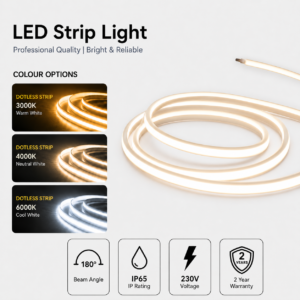
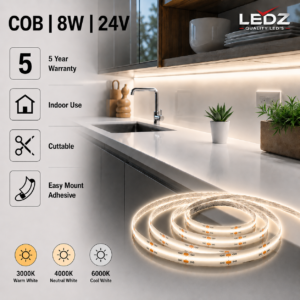
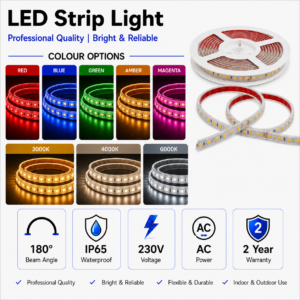
| Colour | Warm White (3000K), Natural White (4000K), Daylight (6000K) |
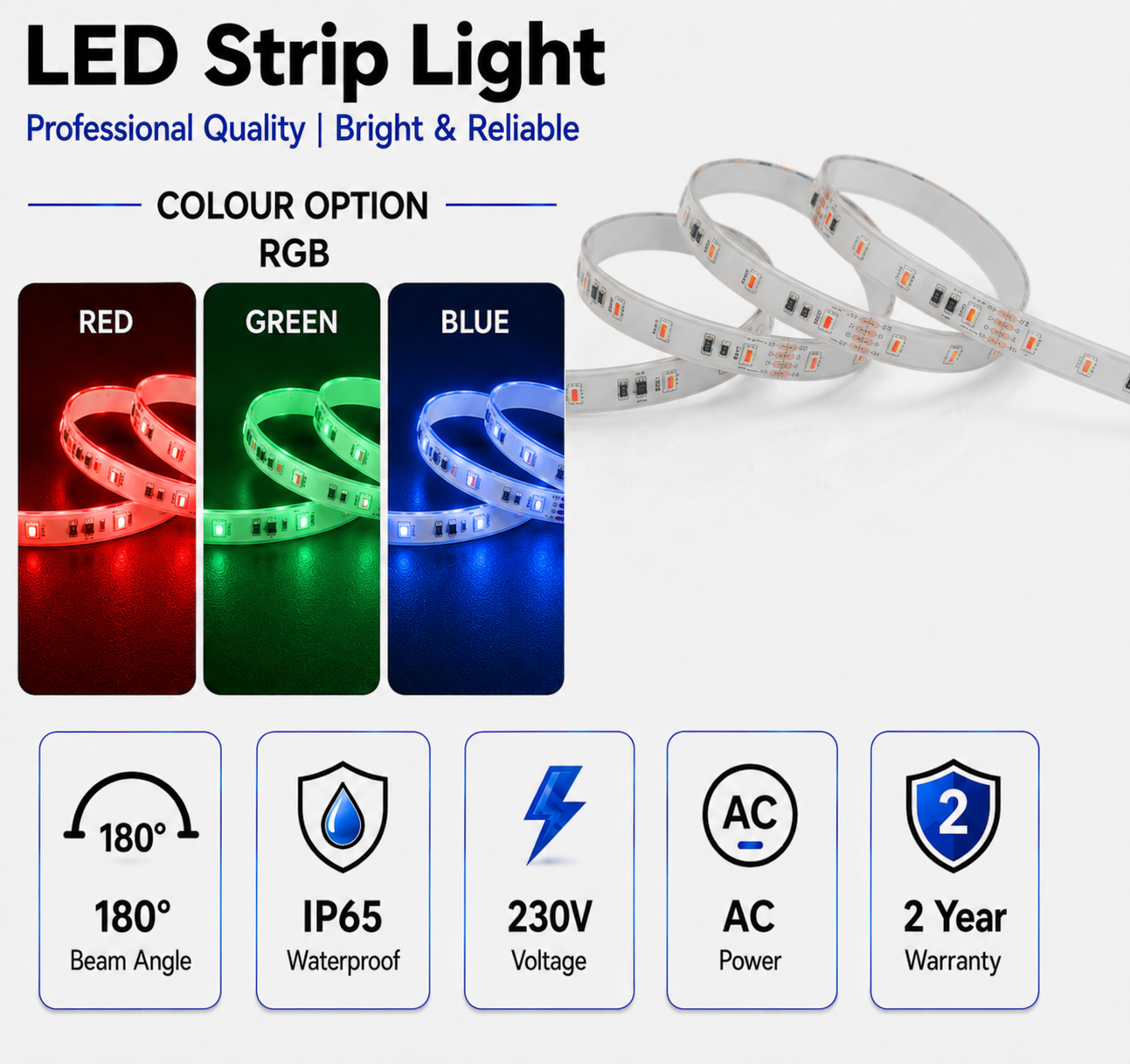
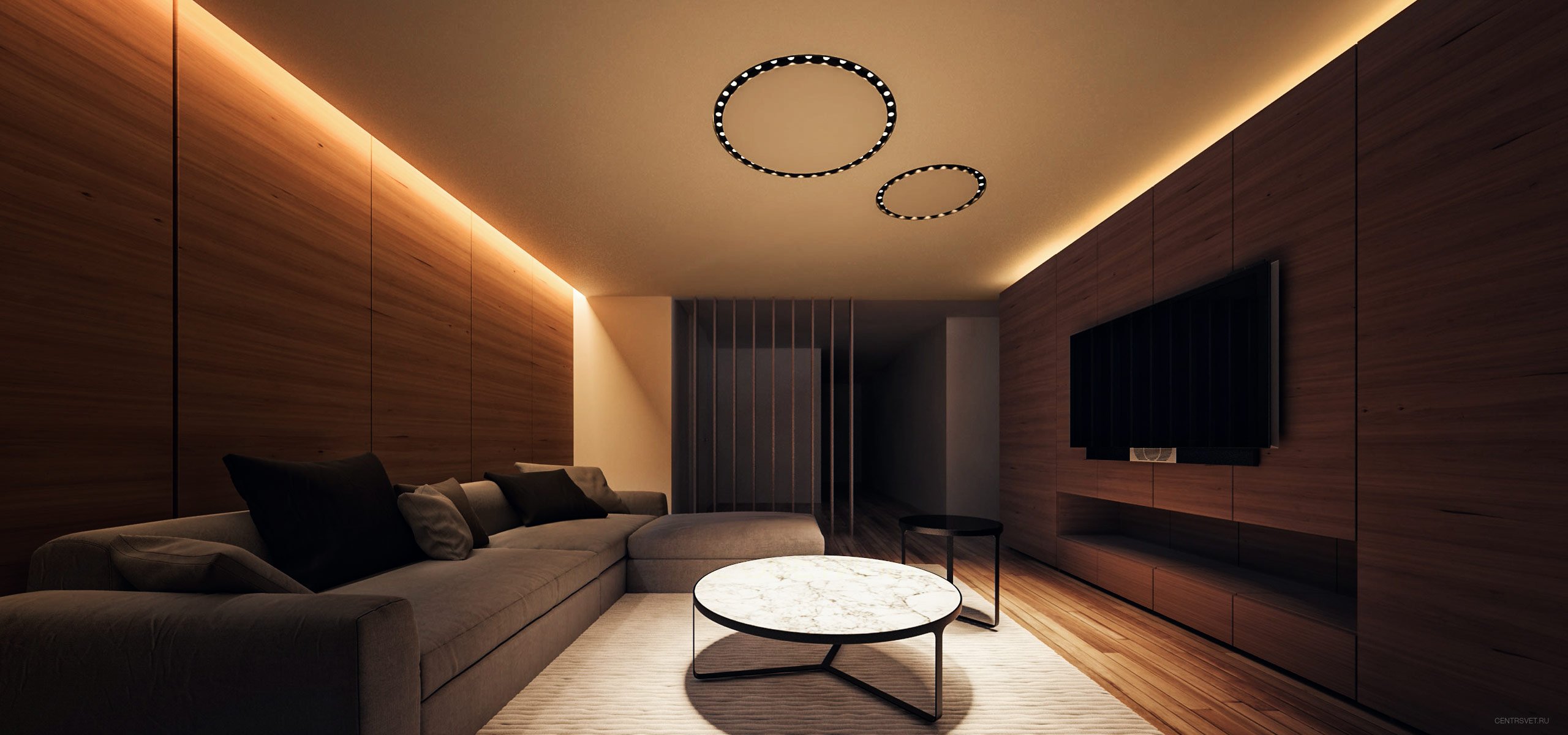
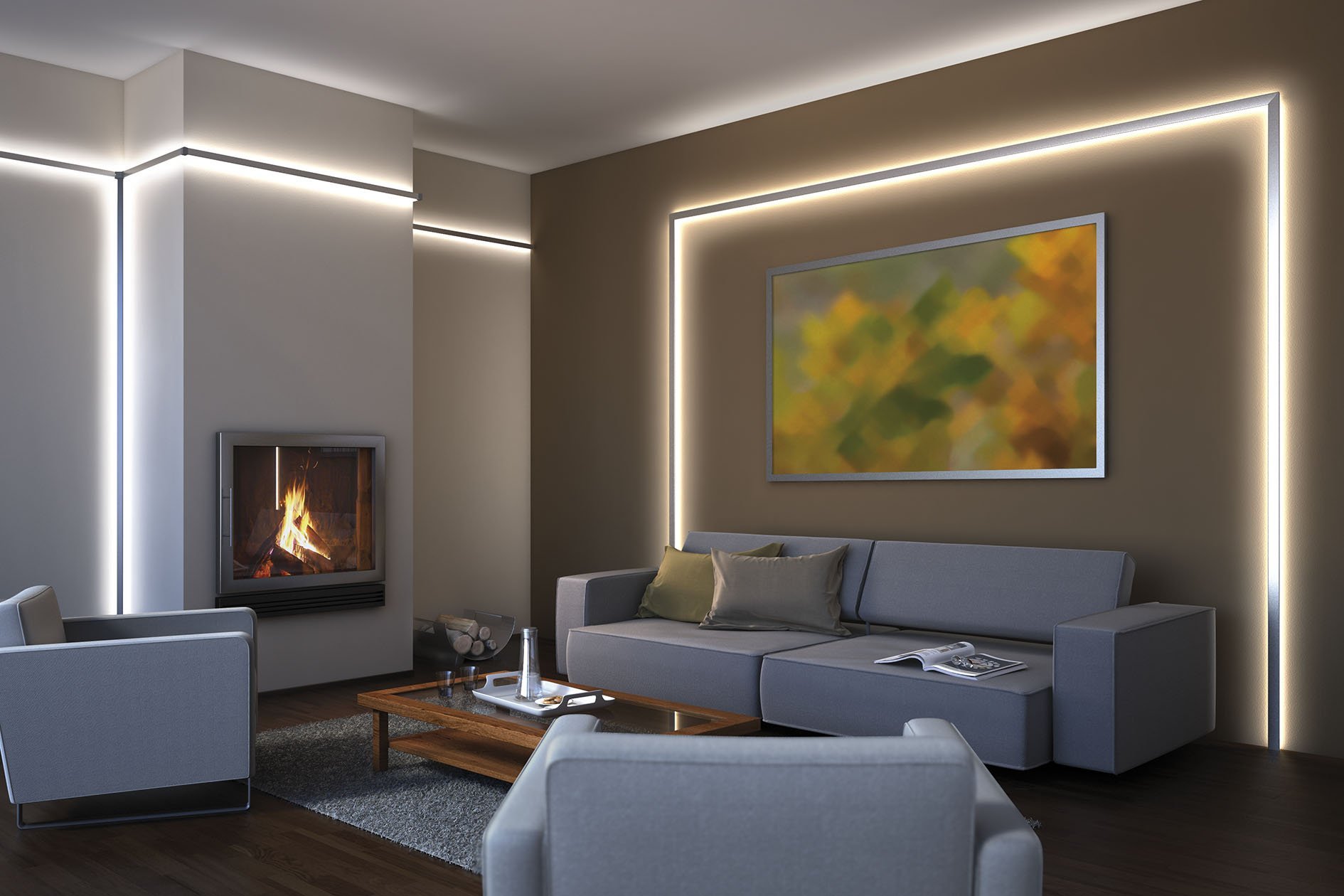
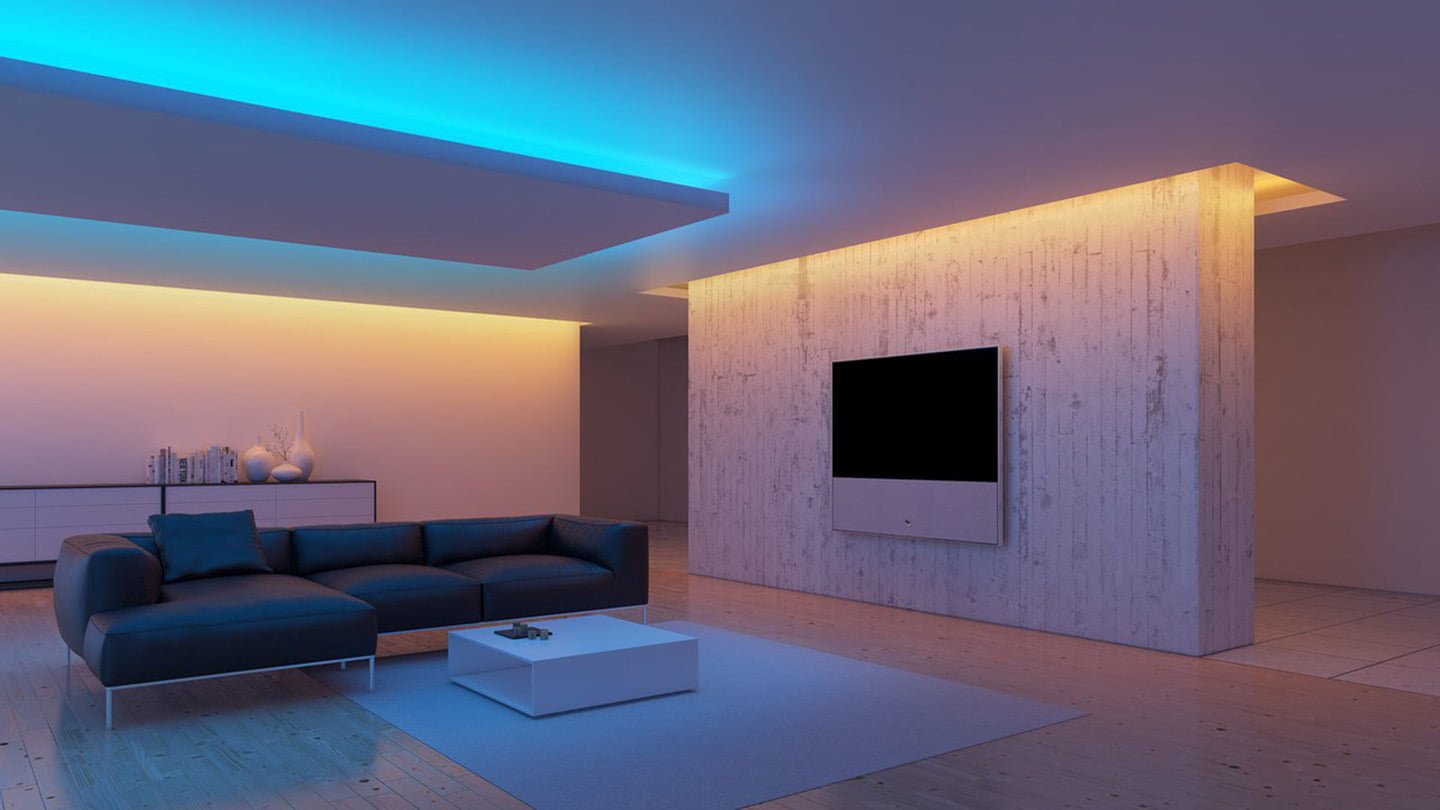
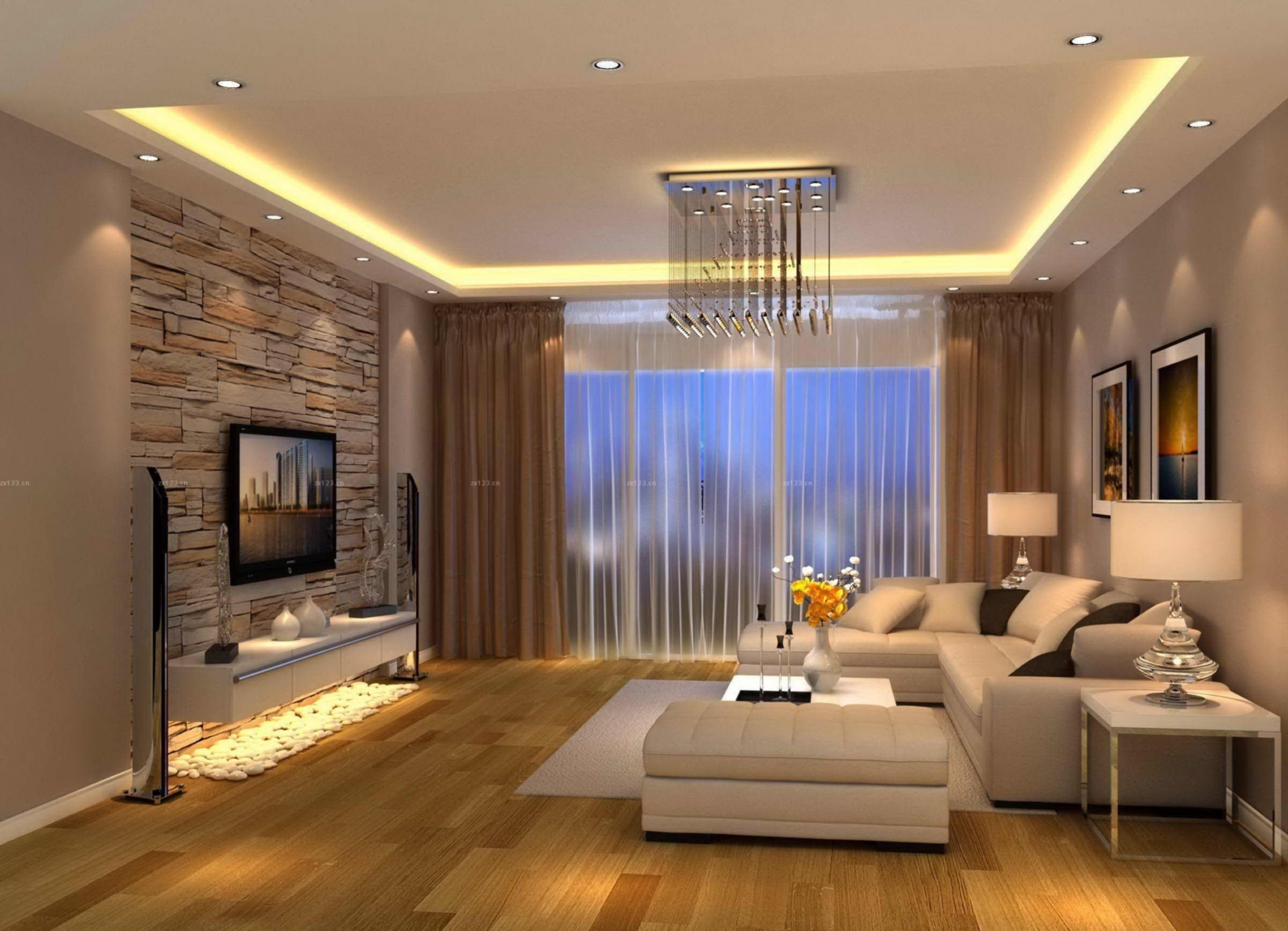
* Actual products may vary slightly due to continuous design enhancments.
Essential Components for a 230V SMD RGB IP65 LED Strip Light Installation
To ensure a safe, reliable, and long-lasting installation, you'll need the following components:
Using quality components and following the correct installation method will improve reliability, protect electrical connections, and help extend the lifespan of your 230V SMD RGB IP65 LED Strip Light installation.
Important: 230V RGB LED strip operates at mains voltage and should be installed by a suitably qualified electrician. Do not treat it like a low-voltage 12V or 24V LED strip. Always use a compatible RGB controller designed for the specific strip.
13W | Colour Changing
Online Price:
R194.00 Original price was: R194.00.R176.00Current price is: R176.00. Vat Incl.
| Input | 230V |
| Watts Per M | 13W |
| Colours | RGB |
| Waterproof | Water Resistant |
| Dimensions | 10mm x 4mm |
| Cut Points | Every 100mm |
| Mounting | Double Sided Tape |
| Warranty | 2 Years |
50 in stock




Essential Components for a 230V SMD RGB IP65 LED Strip Light Installation
To ensure a safe, reliable, and long-lasting installation, you'll need the following components:
Using quality components and following the correct installation method will improve reliability, protect electrical connections, and help extend the lifespan of your 230V SMD RGB IP65 LED Strip Light installation.
Important: 230V RGB LED strip operates at mains voltage and should be installed by a suitably qualified electrician. Do not treat it like a low-voltage 12V or 24V LED strip. Always use a compatible RGB controller designed for the specific strip.
1. What accessories do I require for a basic installation and how do I connect them?
For a general or basic 230V SMD RGB IP65 LED Strip Light installation, you would require:
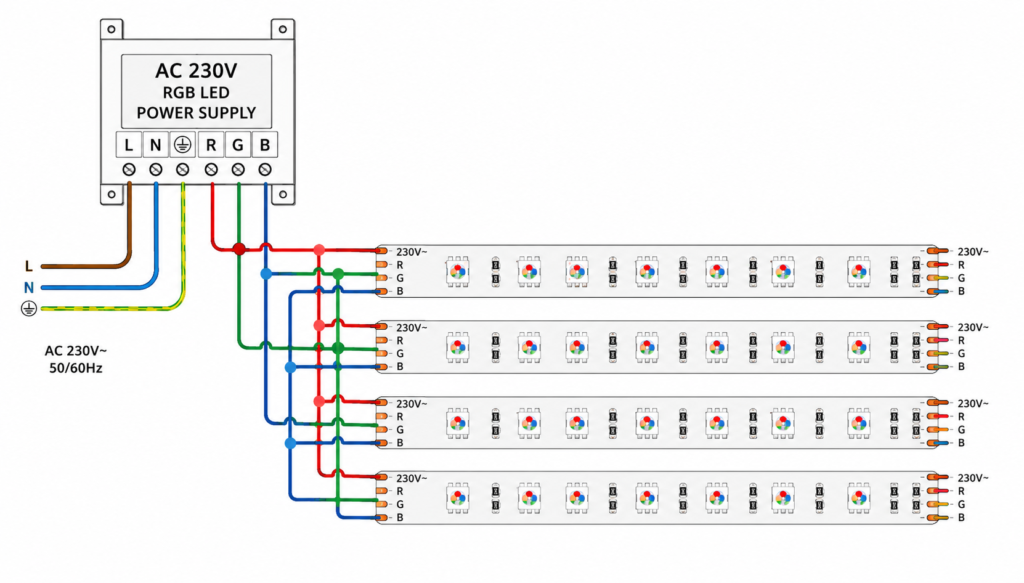
See the installation diagram for guidance.
2. Are there any other items or optional extras that I may need?
Depending on your application, you may need:
3. What Voltage Power Supply would I use?
230V SMD RGB LED Strip Lights are designed to operate from a 230V AC mains supply and do not require a separate 12V or 24V DC power supply.
Never connect a 230V LED Strip Light to a 12V or 24V DC power supply.
Always check the manufacturer's specifications before connecting the strip and RGB controller to the mains supply.
4. What size Power Supply would I need?
A separate low-voltage power supply is not required for a standard 230V RGB LED strip installation.
However, you should calculate the total electrical load of the installation:
Strip Light Length (M) × Power (Watts/M) = Total Power Consumption
Example:
5M × 10 Watts/M = 50 Watts
The electrical circuit, switching equipment, RGB controller, connectors, and cables should be suitably rated for the total load.
Always follow the manufacturer's recommended maximum run length.
5. What are the benefits of installing Aluminium Profiles?
Aluminium Profiles can help to:
6. Can I install 230V SMD RGB IP65 LED Strip Lights myself?
Because the strip operates directly from 230V mains electricity, installation should be treated as a mains electrical installation.
The strip may be straightforward to physically mount, but electrical connections to the mains should be completed by a suitably qualified electrician and in accordance with local electrical regulations.
7. Do you have DIY Kits with everything included?
DIY kits may be available depending on the specific LED strip and application. These can include essential mounting, connection, and RGB control accessories required for a basic installation.
Always check that all included components are specifically compatible with the 230V SMD RGB IP65 LED Strip Light.
8. Can I shock myself?
Yes. 230V LED strip operates at mains voltage and can cause a serious or potentially fatal electric shock.
Always switch off and isolate the mains power before installing, cutting, connecting, or modifying the strip.
Never work on exposed mains wiring unless you are suitably qualified. Where required, have the installation completed or checked by a qualified electrician.
9. Can the Strip Lights bend around corners or curved shapes?
SMD IP65 Strip Lights are flexible, but they should not be sharply bent, twisted, folded, or bent beyond the manufacturer's specified minimum bend radius, as this may damage the strip.
For corners or complex installations, you can use:
Always ensure connections are properly protected and sealed when installing outdoors or in areas exposed to moisture.
10. Can I cut the Strip Lights?
Yes. 230V SMD RGB LED Strip Lights can generally be cut at the clearly marked cut-lines to achieve the required length.
Always disconnect and isolate the mains power before cutting the strip.
After cutting an IP65 strip, the exposed end must be properly sealed using a suitable end cap and silicone sealant to help maintain its IP65 protection.
Only cut the strip at the manufacturer's designated cut points.
11. How are the Strip Lights mounted?
SMD IP65 Strip Lights may have adhesive backing for easy mounting. The mounting surface should be clean, dry, smooth, and free from dust and grease before installation.
For a more secure and long-lasting installation, particularly outdoors, consider using:
12. Can they be controlled and can the colours be changed?
Yes. 230V SMD RGB LED Strip Lights are designed to produce multiple colours and can be controlled using a compatible RGB controller.
Depending on the controller and specific strip, you may be able to:
Always use a compatible 230V RGB controller specifically designed for the particular strip and rated for its total electrical load.
Not all controllers are compatible with 230V RGB LED strips, so always check the product specifications before installation.
For outdoor installations, ensure the controller, connectors, and other electrical components are suitably protected and appropriately rated for the environment.
Important: IP65 protection applies to the LED strip when correctly installed and sealed. It does not automatically make the power connections, plugs, connectors, RGB controllers, or other electrical components waterproof.
230V SMD RGB IP65 LED Strip Light Installation & Setup
Installing a 230V SMD RGB IP65 LED Strip Light is straightforward when the correct components are used and all electrical connections are properly made and protected.
Step 1: Plan Your Installation
Measure the installation area and determine the total strip length required. Check the strip's wattage per metre and calculate the total electrical load to ensure the circuit and accessories are suitably rated. Consider the IP65 rating and whether it is appropriate for the intended indoor or outdoor environment. Plan the location of the compatible RGB controller so it is accessible and suitably protected.
Step 2: Prepare the Mounting Surface
Ensure the surface is clean, dry, smooth, and free from dust or grease. For improved heat dissipation and a professional finish, install the strip on a suitable surface or compatible aluminium LED profile where appropriate.
Step 3: Cut the Strip (If Required)
Only cut the LED strip at the manufacturer's marked cut points. Cutting elsewhere may damage the strip. After cutting, the exposed end must be properly sealed using a suitable end cap and silicone sealant to help maintain the IP65 protection.
Step 4: Connect the Strip and RGB Controller
Connect the strip using compatible 230V RGB LED strip connectors or the appropriate connection method according to the manufacturer's instructions. Connect the compatible RGB controller as specified for the particular strip. Ensure all connections are secure, insulated, and suitably protected against environmental exposure.
Step 5: Test Before Mounting
Test the strip briefly to confirm that all sections illuminate correctly and that the RGB controller operates the colours and lighting effects as expected before permanently fixing it in place. Never operate the strip while it is tightly wound on the reel, as this can cause excessive heat buildup and damage the LEDs.
Step 6: Secure the Strip
Remove the adhesive backing, where provided, and press the strip firmly onto the prepared mounting surface or into a compatible aluminium profile. Avoid excessive bending, twisting, or sharp bends during installation.
Step 7: Seal and Protect Connections
For outdoor installations, ensure all cut ends, connectors, joints, controller connections, and cable entry points are properly sealed. Use suitable waterproof end caps, heat shrink tubing, connectors, and silicone sealant where required to help prevent moisture from reaching the strip or electrical connections.
Step 8: Connect to 230V Mains Power
Connect the LED strip and compatible RGB control equipment to a suitable 230V AC mains supply using the correct connection method and appropriate electrical protection. 230V RGB LED strip operates at mains voltage and should be installed by a suitably qualified electrician. Always follow local electrical regulations and the manufacturer's installation instructions.
Installation Tips
Following these steps will help ensure reliable performance, vibrant and consistent RGB colour output, effective moisture protection, and a long service life from your 230V SMD RGB IP65 LED Strip Light installation.
LED strip won't turn on
Strip is dim or unevenly lit
Only part of the strip lights up
Colours are incorrect or not changing
Flickering lights
Adhesive won't stick
Following these recommendations will help maximise the performance, colour consistency, reliability, moisture protection, and lifespan of your 230V SMD RGB IP65 LED Strip Light while reducing the likelihood of installation issues.
To ensure safe installation and reliable operation, follow these important safety guidelines:
Following these safety precautions will help ensure a safe installation, reliable performance, vibrant RGB colour output, effective moisture protection, and a long service life for your 230V SMD RGB IP65 LED Strip Light.
230V SMD RGB IP65 LED Strip Light Applications & Use Cases
230V SMD RGB IP65 LED Strip Lights are a versatile lighting solution suitable for residential, commercial, architectural, entertainment, and outdoor projects. Their SMD LED technology provides bright and consistent RGB colour-changing illumination, allowing you to create vibrant, dynamic, and customisable lighting effects. The IP65 protection provides added resistance to dust and water exposure, making them suitable for areas where additional environmental protection is required.
Common applications include:
The 230V design allows the strip to be connected directly to an appropriate 230V mains supply without requiring a separate low-voltage power supply, making it suitable for longer installations where supported by the manufacturer's specifications. RGB controllers and compatible accessories are required to control the colour-changing functions of the strip.
For outdoor installations, ensure that all connections, end caps, joints, controllers, and cable entry points are properly sealed and suitable for the environmental conditions. Installation and mains electrical connections should be carried out by a suitably qualified person.
230V SMD RGB IP65 Waterproof LED Strip Lights
Our 230V SMD RGB IP65 Waterproof LED Strip Lights provide vibrant, customisable illumination, making them ideal for decorative and ambient indoor and outdoor lighting applications. Using SMD (Surface-Mounted Device) LED technology, these strips deliver bright and consistent RGB colour lighting across a wide range of applications. The IP65 protection helps guard against dust and water exposure, making them suitable for outdoor accents, signage, architectural features, retail displays, entertainment areas, shelving, and residential or commercial installations where additional protection is required.
LED STRIP LIGHT SMD 230V 13W/M
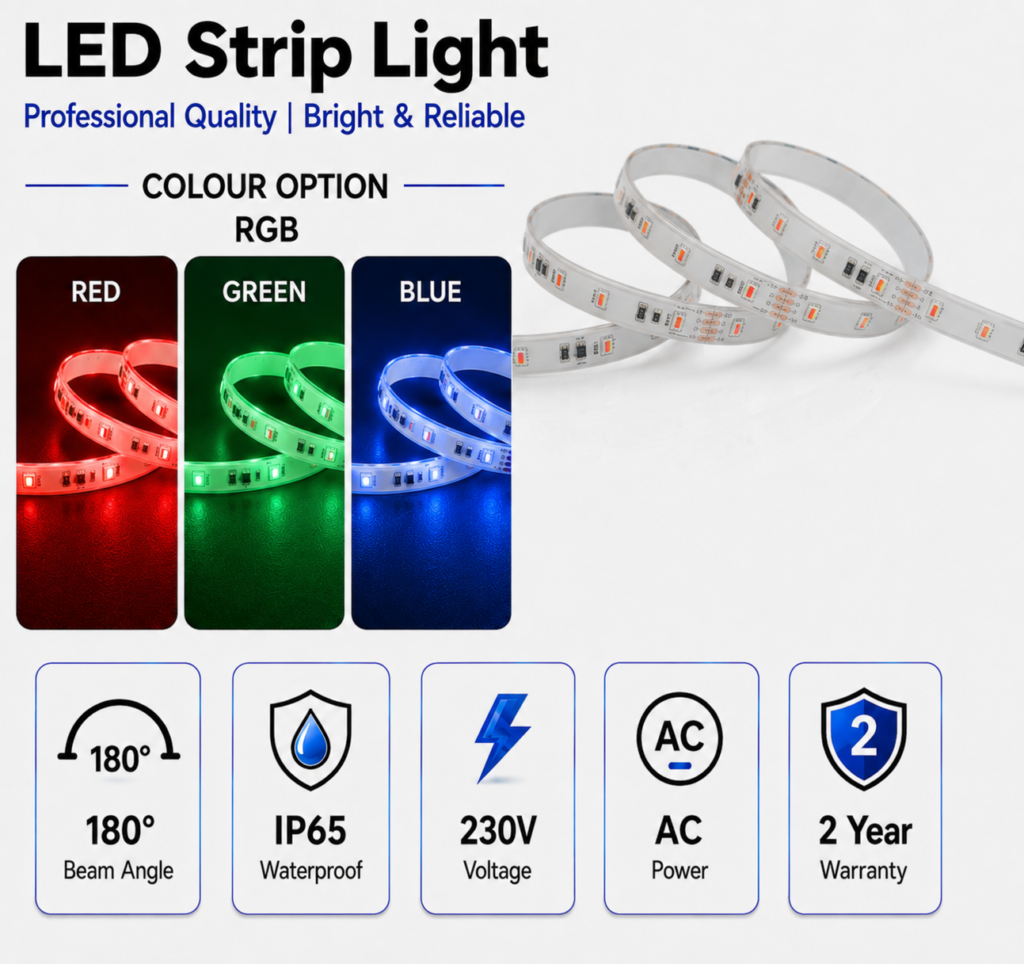
LED Strip Light Dimensions: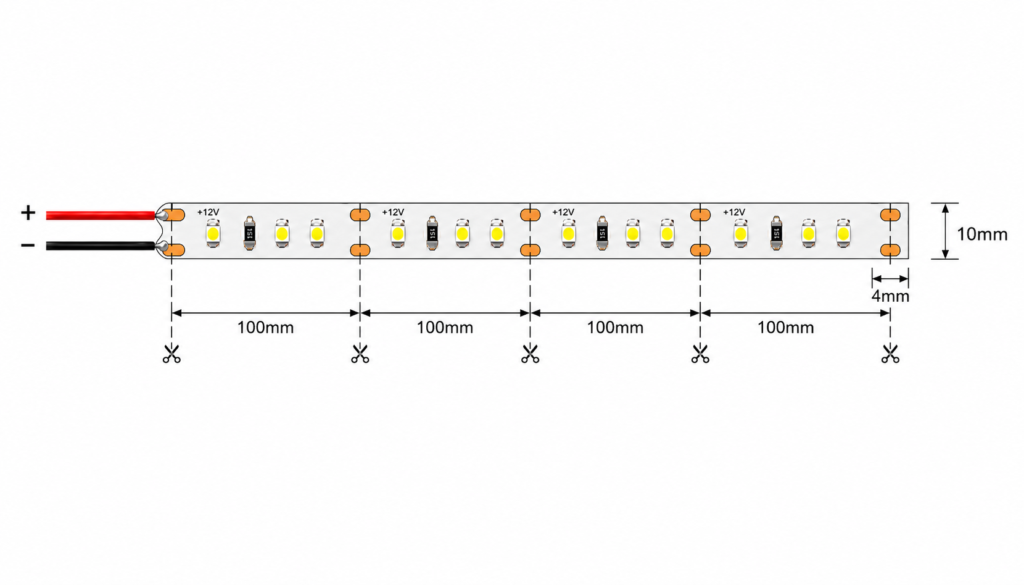
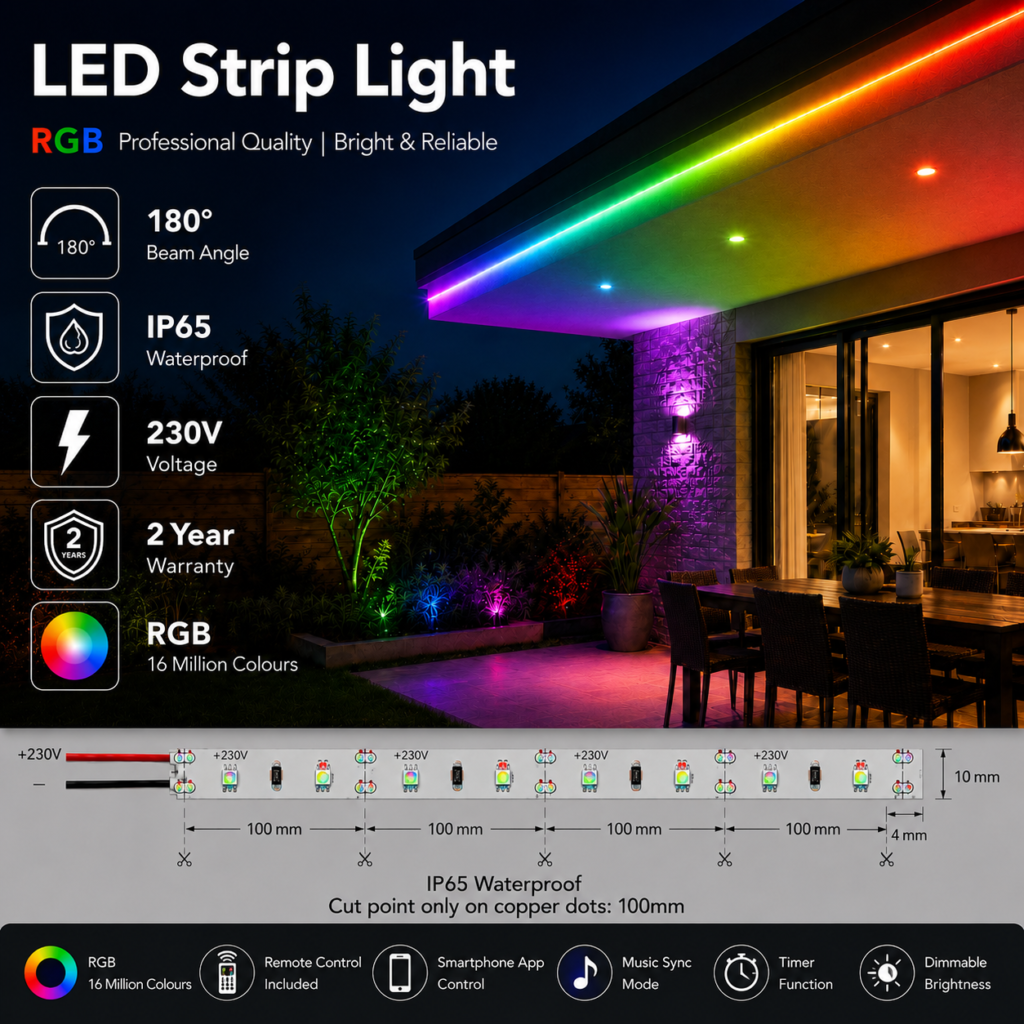
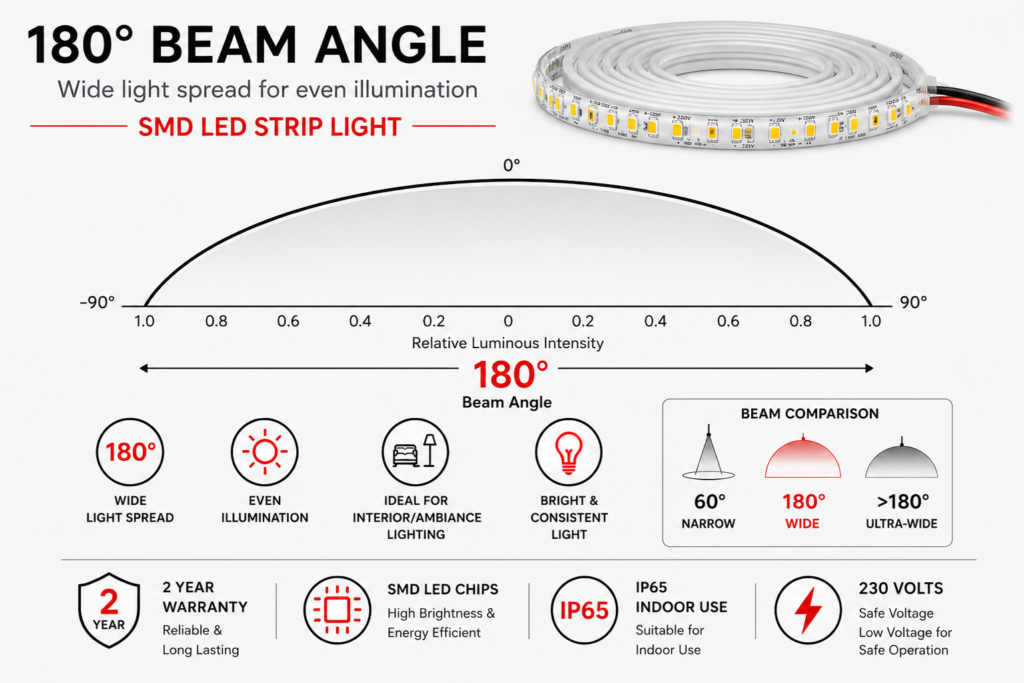
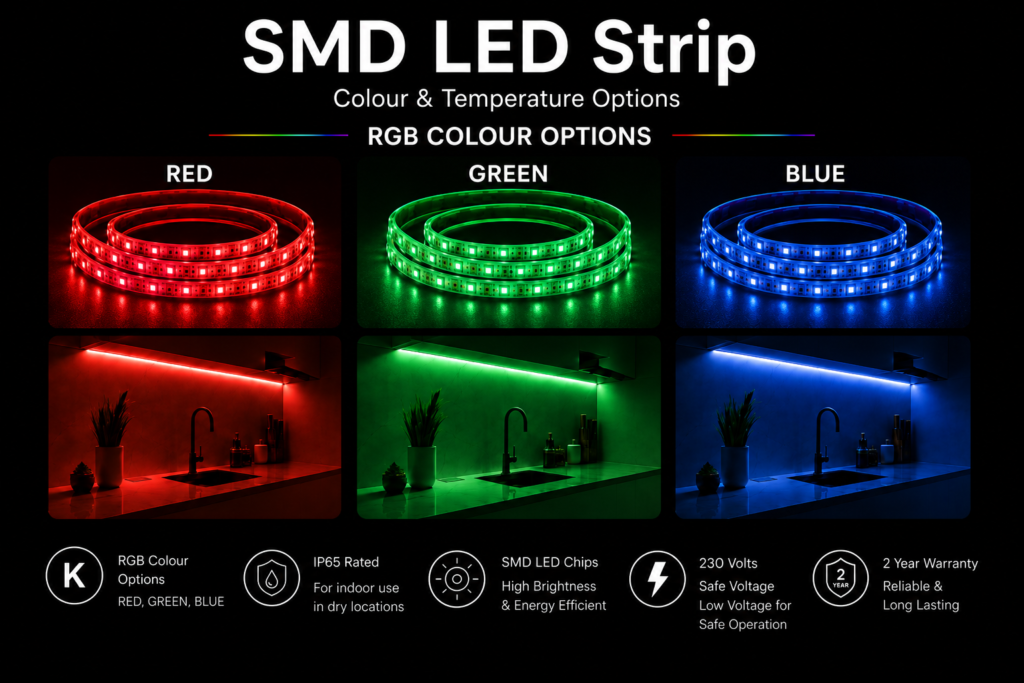
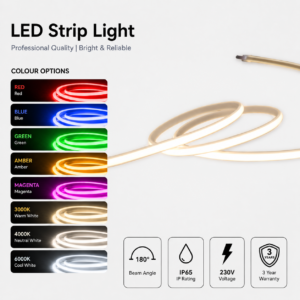
Color of LED Strip Light
LED Strip Light Distribution Graph
LED Strip Light Installation
| Weight | 0.2 kg |
|---|---|
| Dimensions | 5 × 5 × 2 cm |
| Colour | Warm White (3000K), Natural White (4000K), Daylight (6000K) |
WhatsApp us


Reviews
There are no reviews yet.